Biography
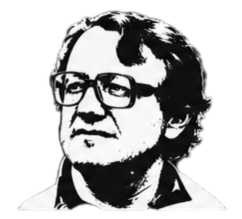
Ales Adamovich
Writer, publicist, literary scholar, screenwriter, and public figure.
Ales Adamovich belongs to those authors for whom literature was not only an art, but also a form of responsibility. He wrote about war, memory, human dignity, and the danger of oblivion.
1927–1940
Childhood and Hlusha
Family, early years, and the place that became Adamovich’s true home ground.
- #family
- #Hlusha
- #childhood
Ales Adamovich was born into a family of employees on September 3, 1927, according to his official documents. His actual birth date was August 3, 1926: during the war, his mother altered the date on his school certificate to protect him from being deported to Germany.
He was born in the village of Kaniukhy, Kapyl District, Minsk Region. “The most mysterious, legendary place in my biography is Kaniukhy itself, where I was born... I remember nothing of life there...”
His father, Mikhail Iosifovich Adamovich (1902–1948), came from the village of Rachen in Slutsk District. He studied medicine and worked at the Kapyl holiday home during university vacations. After graduating from the medical faculty of Belarusian State University, which he entered in 1923, he was assigned to permanent work in Hlusha, Babruisk District, Mahiliou Region, in 1928.
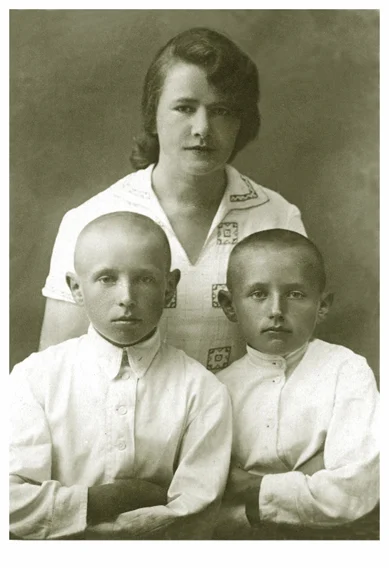
He moved to Hlusha with his wife Hanna Mitrafanauna (1904–1979), from the village of Zabalotstse in Liuban District, who graduated from the Mahiliou School of Pharmacy in 1935–1936, and their sons: Yauhen (1924–1992), who would become a doctor, and Aliaksandr. “My true home ground, where I came of age and entered life, was the workers’ settlement of Hlusha. The Soviet clarification: the Comintern glassworks.”
In 1930, Ales Adamovich’s grandfather, Mitrafan Famich Tychyna, was dispossessed and exiled with his wife and three of their seven children to distant, cold Yakutia. The authorities repeatedly reminded Adamovich’s mother that she was the “daughter of a kulak.” His grandfather remained forever in Yakut soil; the other family members returned to Belarus. These events echoed through many of Adamovich’s works.
In Hlusha, the future writer attended school from the first through the seventh grade. He loved books, especially Alexander Pushkin, and reread Leo Tolstoy’s War and Peace many times. His strongest male role models were his father and his uncle Anton, his mother’s brother and a mathematics teacher.
Mikhail Iosifovich Adamovich secured the construction of a hospital in Hlusha and became its director. In Ales Adamovich’s words, the “radius of authority of a rural doctor” deservedly extended beyond the settlement to the entire surrounding area. From January 1940, his father served in the military. He was at the front from the first days of the war, worked as a physician with the 13th Army under Nikolai Pukhov, and rose to the rank of lieutenant colonel in the medical service.
1941–1945
War, Memory, and the Human Limit
Partisan experience and the first encounter with what would become the central theme of his work.
The underground movement in Hlusha, the partisan unit, danger, and death nearby became part of Adamovich’s personal memory.
This experience later returned in his prose, screenplays, and documentary books.
1946–1959
Section in progress.
1960s
Section in progress.
1970s
Section in progress.
1980s
Section in progress.
1990s–2000s
Section in progress.